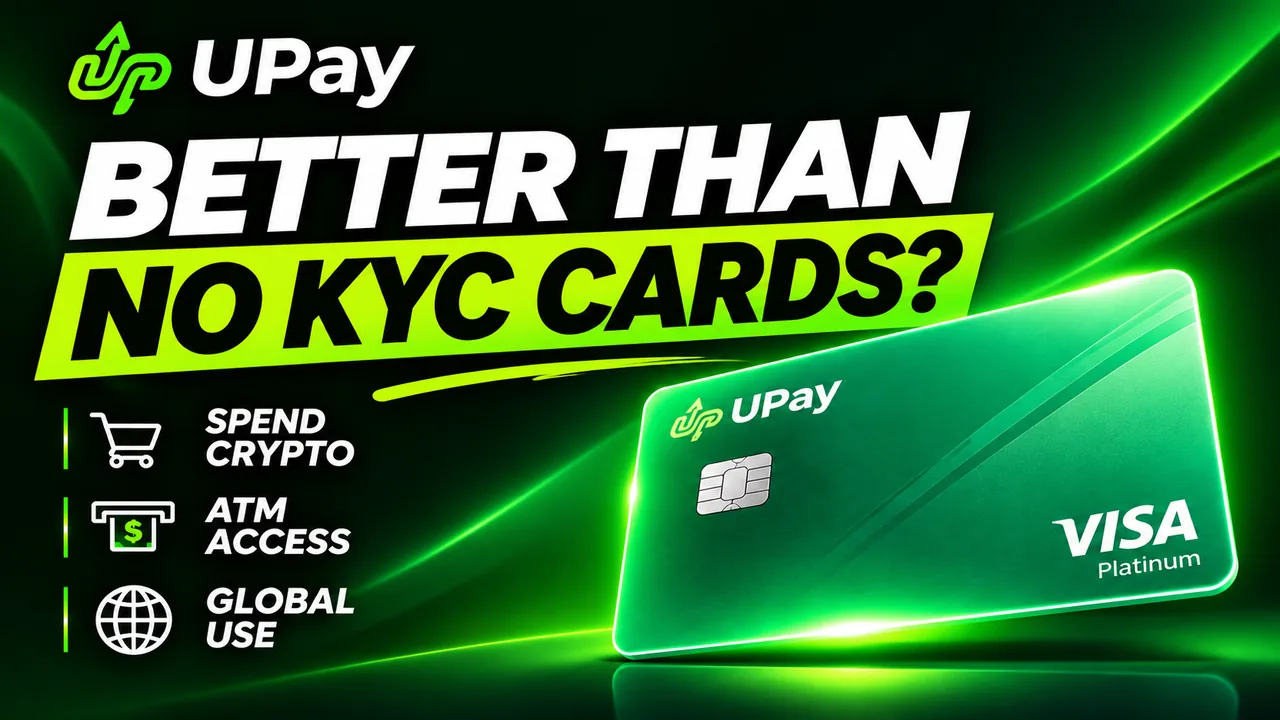
The crypto space is full of hype around no KYC debit cards. On the surface, they sound great. Anonymous. Quick setup. Total freedom.
But when you look at how they actually work in the real world, many of them fall short.
Lower limits. Weak support. Random freezes. Patchy global acceptance. Restrictions that only show up when you actually try to use the card.
That is why I have been testing a different option. And right now, for everyday spending, I believe it is more useful than most no KYC cards I have looked at.
*Disclosure: I have personally tested the UPay card and have previously received sponsorship from UPay for YouTube content. This article contains affiliate links, which means I may earn a commission if you apply through them. Full details are in the disclosure section below.*
Quick Answer
UPay is not a no KYC card. It requires identity verification, so this article is not presenting it as a way to avoid KYC. No KYC cards can appeal to people who want minimal verification and more privacy, but depending on the provider they may also come with lower limits, weaker support, regional restrictions or a request for verification later on. My reason for preferring UPay is practical, everyday usability, not anonymity. If avoiding identity checks is your top priority, this is not the card for you. If you want a crypto card that simply works when you use it, keep reading.
First, UPay Is Not a No KYC Card
UPay requires identity verification. That matters, because this article is not claiming UPay is anonymous or a way around KYC.
I am comparing it with no KYC crypto cards because many people searching for those cards are really looking for something broader: an easier way to spend crypto, fewer banking headaches, reasonable limits, international usability and a card that works in the real world.
Those goals are not the same thing as avoiding identity verification.
That distinction runs through this whole article.
If you want the full breakdown and real world testing, watch the video here:
Prefer watching on YouTube? Click here.
Key Benefits
These are the features that made the card stand out to me. Exact fees, limits and features depend on which UPay card you have and where you live, so always check the current terms for your card and country inside the app before applying.
Earn interest on idle crypto
According to UPay, it offers a savings feature where you can lock certain crypto assets for a fixed term and earn interest. Your balance does not have to just sit idle. Rates and terms are set by the provider and can change.
Low cross border and top up costs
UPay publishes a fee schedule for each card and country. On the schedules I have seen, cross border fees are low or zero and the main cost is a transaction fee of around 1 percent, which is cheaper than many alternatives. Check the schedule for your own card, because it is not identical everywhere.
ATM access on supported cards
ATM withdrawals depend on the card type. According to UPay's help centre, virtual cards do not support ATM withdrawals, while its physical card does, with its own withdrawal limits and fees. If cash access matters to you, confirm which card you are getting.
Higher limits than typical no KYC tiers
Because the account is verified, the limits I have been working with are far beyond what most low or no verification cards allow. Exact limits vary by card and account, so check yours before relying on them for large payments.
If you want to get the card with exclusive bonuses, apply here using your mobile phone:
UPay vs a Typical No KYC Crypto Card
This is a general comparison. No KYC cards are not all the same, so the right hand column describes common patterns, not rules that apply to every provider.
| Feature | UPay | Typical No KYC Crypto Card |
|---|---|---|
| Identity verification | Required before applying | Minimal or none at entry level, varies by provider |
| Privacy emphasis | Not the selling point | Usually the main selling point |
| Typical usage limits | Higher limits for verified users, varies by card | Often limited at low or no verification tiers |
| Physical card availability | Virtual and physical options, depending on card and region | Often virtual only, varies by provider |
| ATM access | Physical card only, with its own fees and limits | Often unavailable or limited |
| International use | Available in many countries, check yours | Varies widely, some regions excluded |
| Account recovery and support | Verified account makes recovery more straightforward | Can be harder when the provider knows little about you |
| Possible later verification | Already completed | May be requested above certain limits or after reviews |
| Everyday usability | Designed for regular spending | Fine for small, occasional use with some providers |
| Best suited for | Regular crypto spenders comfortable with KYC | People prioritising minimal identity disclosure for limited use |
What Does "No KYC" Actually Mean With a Crypto Card?
"No KYC" usually means you can get started without full identity verification. It does not always mean that stays true forever, or at every spending level.
In practice, "no KYC" does not necessarily mean:
- unlimited anonymous use
- no compliance checks ever
- no account monitoring
- no geographic restrictions
- no chance of being asked to verify later
Depending on the provider, a "no KYC" product might be:
- a limited virtual card that works without full verification
- a card with low spending thresholds before checks apply
- a card where verification kicks in at higher limits
- a product with different rules in different countries
- an account that can trigger extra checks through risk or compliance systems
None of that makes no KYC cards bad. It just means the label tells you less than the marketing suggests. Read the provider's terms, especially the parts about limits and verification, before you load funds.
Why I Prefer This to Most No KYC Cards
No KYC cards sound attractive in theory, but in practice they can come with real tradeoffs.
- Lower limits for spending and withdrawals
- Providers that change terms or disappear
- Sudden freezes or blocked transactions
- Weak or slow customer support
This card takes the opposite approach.
- Higher limits for verified users
- Published fee schedules
- A compliance process built in from the start
- Wider usability for everyday spending
This is not me saying KYC is good and privacy is bad. The point is narrower than that.
If you want to actually spend crypto regularly, practical usability can matter more than avoiding identity verification.
Think about what happens when something goes wrong. A payment gets declined abroad. You lose your phone. A transaction is flagged. With a verified account, you are a known customer, and support can actually work through the problem with you. With an account built around knowing as little about you as possible, recovery can be harder, depending on the provider.
Limits matter too. A card that caps you at a small amount is fine for a coffee or a subscription. It is much less useful for travel, bigger purchases or regular monthly spending.
And the form factor matters. If the card is virtual only, you may have no ATM access and may be limited to online or mobile payments. That is a real constraint for some people.
It is not about avoiding KYC at all costs. It is about using a card that actually works when you need it.
Real World Perspective
I have personally used this card without major issues. It has been reliable, flexible and practical for day to day use.
What I liked most was that it behaved like a normal card. I did not have to think about whether a payment would go through or whether I was about to hit a hidden limit. For a crypto card, that is honestly the highest compliment.
The tradeoff was obvious from the start: I had to verify my identity. For me, that was a small price for a card I could rely on. For someone whose main goal is privacy, it will not be.
No solution is perfect. I would still be cautious about a few things: understanding exactly which card you are applying for, reading the fee schedule for your country, and knowing how any collateral or credit arrangement works before you use it. Those details matter more than any headline feature.
If you want to see the full breakdown, real tests and my honest experience, the video is embedded above.
Or apply for the card with exclusive bonuses here:
Can a Crypto Card Really Replace a Bank Card?
For most people, a crypto card is best seen as a spending tool, not a complete replacement for everything a regulated bank account does.
It can cover a lot of everyday spending: shopping, online payments, travel purchases and, on supported cards, ATM withdrawals. For some people that is most of what they use a bank card for.
But a bank account usually does more than that:
- Salary and direct deposits: most crypto cards are not designed to receive your wages.
- Banking services: loans, overdrafts, savings accounts and payments in local currency are usually tied to a bank.
- Deposit protection: many countries protect bank deposits up to a limit. Do not assume the same applies to crypto card balances or collateral. UPay is not a bank, and its card is issued by a separate company.
- Custody and collateral risk: with some cards, including UPay's, your crypto may be pledged as collateral and could be liquidated to cover what you owe.
- Support and disputes: fraud and chargeback protections may differ from a traditional bank issued card.
So yes, a crypto card can be a useful alternative to a bank card for spending. Just do not treat it as a full replacement for your bank without understanding those differences.
Who UPay May Suit
- Crypto holders who want a practical way to spend in everyday life
- People who value usable limits and responsive support
- Frequent travellers, where the card is supported in the countries they use it
- Users who are comfortable completing identity verification
- People who understand the custody and counterparty risks of a crypto card
Who May Prefer a No KYC Crypto Card
To be fair, there are good reasons someone might choose a no KYC card instead.
- Someone who prioritises minimal identity disclosure
- Someone who only needs low value or occasional use
- Someone who understands and accepts the specific provider's limits, restrictions and risks
Wanting privacy is not suspicious. It is a legitimate preference. It just comes with tradeoffs you should go into with your eyes open.
Who Should Avoid Either Option
A crypto card, KYC or not, may not be right for you if you:
- do not understand how custody or collateral works on the card
- cannot tolerate counterparty risk
- expect the same protections as a normal bank account without checking them
- are unsure about your own tax and reporting obligations
Your tax and reporting obligations depend on where you live and your circumstances. A card's KYC model does not remove those obligations.
No BS Verdict
UPay requires KYC. If avoiding identity verification is your number one priority, it is not the card for you.
But that was never why I preferred it.
If you actually want to spend crypto regularly, things like usability, limits, ATM access, support and reliability can matter more than whether the application asks for ID.
That is the tradeoff this article is about. It is not the best card for everyone. It is the one that made the most sense for how I use crypto.
Want Better Crypto Tools and Strategies
Before spending crypto, make sure your storage setup is right. Here is my guide on choosing the right wallet based on how you actually use crypto.
You can also browse the wallets, cards and platforms I use in my crypto tools and resources hub.
If you are serious about crypto and want better timing, cleaner entries and structured exits, explore the system and indicator I use in my own trading:
For more real world crypto insights, market psychology and practical breakdowns, subscribe to The Crypto Factor on YouTube:
Disclosure and Disclaimer
I have previously received sponsorship from this company in connection with my YouTube content. This article is not sponsored, but it does contain affiliate links, which means I may earn a commission if you sign up through them.
This content is for information and entertainment purposes only. I am not a financial, legal or tax expert. Some parts of this research were assisted by AI and may be incomplete or inaccurate. Always do your own research and consult a qualified professional before making financial decisions.
Important details:
- The card is issued by JC Credit Limited, a licensed money lender in Hong Kong.
- UPay provides the app but is not the card issuer and is not a bank.
- Use of the card may involve pledging assets, including crypto, as collateral. Those assets may be liquidated to cover amounts owed.
- Fraud and chargeback protections may differ from traditional bank issued cards.
- Terms, fees, credit limits and rewards can change at any time.
- Disputes and governing law are in Hong Kong.
- Availability and consumer protections vary by country.
- Always read the full Cardholder Agreement on the official website before applying.
Frequently Asked Questions
Is UPay a no KYC crypto card?
No. UPay requires identity verification. This article compares it with no KYC cards because many people searching for those cards really want a crypto card that is easy to use, not necessarily one that avoids verification.
What is a no KYC crypto card?
A no KYC crypto card lets you start using it without full identity verification. Exact thresholds and rules vary by provider and country, and some ask for verification at higher limits.
Can a no KYC crypto card ask for verification later?
Yes, it can. Depending on the provider's terms, your usage, compliance reviews and your country, a card marketed as no KYC may still request identity verification later.
Are no KYC crypto cards safe?
It depends on the provider. Some are run responsibly, others less so. Check who issues the card, how funds are held, what limits apply and how support works before loading money onto any card.
Are no KYC crypto cards legal?
There is no universal answer. Legality and availability depend on the provider, the product and where you live. Check your local rules and the provider's terms.
Can a crypto card replace a bank card?
It can replace some spending functions, such as shopping, online payments and, on supported cards, ATM withdrawals. It is not necessarily a substitute for all banking services or protections, such as salary deposits or deposit insurance.
What is the difference between a crypto debit card and a normal debit card?
A normal debit card spends money from your bank account. A crypto card is funded with crypto, which is converted or used as collateral when you pay, so the merchant still receives regular currency. The fees, protections and risks can differ.
What is the best crypto card without KYC?
There is no single no KYC card that is best for everyone. Availability, limits, verification thresholds, fees and supported countries vary significantly. This article intentionally explains why I chose a card that does require KYC instead.
Does using a crypto card remove tax or reporting obligations?
No. Using a particular card, or completing or not completing KYC, does not by itself remove your tax or reporting obligations. Those depend on where you live and your circumstances.
Is a no KYC crypto card always better than a verified one?
Not necessarily. No KYC cards offer more privacy at entry level but can come with lower limits, weaker support and fewer protections, depending on the provider. A verified card can offer higher limits, better support and broader usability.
What tradeoffs should users consider when choosing a crypto debit card?
The main tradeoff is between privacy and usability. No KYC cards prioritise minimal verification but may restrict spending or regions. Verified cards require identity checks but typically offer a smoother everyday experience.
What should users actually compare between crypto cards?
Focus on spending limits, supported currencies and countries, real world acceptance, fees, customer support and whether the card works reliably where you live. Marketing claims matter less than how the card performs in everyday use.
Who is this crypto debit card best suited for?
It is best suited for crypto holders who want a practical way to spend crypto in the real world and are comfortable completing identity verification. It works well for people who value higher limits and consistent performance over the privacy of no KYC alternatives.