
Every few years, the same phrase takes over the internet. Crypto is dead.
You have probably seen it before. If you have been in this market for any real amount of time, you have definitely heard it before. The headlines repeat. The panic spreads. The same people who were calling for 100,000 dollar Bitcoin six months ago are suddenly asking whether the entire industry is finished.
Since 2017, I have watched this cycle play out multiple times. Each time, the narrative feels more convincing. Each time, the crowd genuinely believes that this is the end. And each time, the people who panicked ended up regretting it. During the previous market cycle I was briefly featured on HBO's documentary Electric Money discussing Bitcoin market conditions.
Crypto is not dead. What changes are the narratives, the technology, and investor behavior. Understanding the difference between noise and structural reality is what separates long term survivors from people who buy high and sell low over and over again. This reflects the philosophy behind The Crypto Factor.
This article breaks down why "crypto is dead" keeps trending, what the data actually shows, and how experienced investors navigate these cycles. Most people confuse bear markets with crypto is dead headlines, but a real bear market starts when market structure breaks.
Is Crypto Dead?
No. Crypto is not dead.
Crypto markets move in cycles. During bear markets prices fall, media narratives become negative, and many investors leave the space. However the underlying technology, infrastructure, and development continue to grow.
Since the early days of Bitcoin the industry has repeatedly gone through phases where headlines declared crypto dead. Yet each cycle introduced major innovations such as decentralized finance, NFTs, AI powered crypto tools, and decentralized exchanges.
In reality what changes is not whether crypto survives, but which projects, technologies, and narratives dominate the next cycle.
Quick Summary
Before we go deep, here is the short version.
- Crypto markets move in cycles. Bear markets, bull markets, and accumulation phases repeat in a pattern that has held for over a decade.
- Narratives shift with each cycle. What drives one bull market is rarely the same thing that drives the next.
- Innovation continues regardless of price action. Builders keep building even when prices are down.
- Long term infrastructure keeps growing. Hash rate, developer activity, institutional participation, and real world adoption continue to expand.
If all you needed was a quick answer: no, crypto is not dead. If you want to understand why, keep reading.
Why People Think Crypto Is Dead
There are several reasons why the "crypto is dead" narrative resurfaces every cycle.
Price crashes. When Bitcoin drops 30, 50, or even 80 percent, it feels catastrophic. For people who bought near the top, it looks like the end. But price drops are not the same as protocol death. Bitcoin has dropped over 80 percent multiple times and recovered to new all time highs every single time.
Media panic headlines. Fear generates clicks. When prices fall, every major news outlet runs headlines declaring the death of crypto. These articles are not analysis. They are engagement farming. And they work because scared people seek confirmation of their fear.
Failed projects. Every cycle produces hundreds of projects that collapse. Luna. FTX. Celsius. BitConnect. When high profile failures happen, people assume the entire industry is broken. In reality, the failures are a sign that the market is clearing out weak, fraudulent, or poorly designed projects.
Exchange collapses. When major platforms like FTX implode, trust is destroyed overnight. People lose money. The media runs with the story for months. But the collapse of a centralized exchange is not the same as the collapse of decentralized protocols or Bitcoin itself.
Unrealistic expectations. Many people enter crypto expecting to get rich quickly. When that does not happen, or when they lose money, they declare the whole thing a scam. The problem was never the technology. The problem was the expectation.

The psychology behind all of this is well documented. Markets move through emotional phases: optimism, euphoria, panic, capitulation, and accumulation. The "crypto is dead" searches almost always peak during the capitulation phase, which historically marks the bottom, not the top.
How Many Times Crypto Has "Died"
The concept of "Bitcoin Obituaries" has been tracked for years. Every time a major publication or prominent figure declares Bitcoin dead, it gets recorded.
| Year | Event | Bitcoin Price After Recovery |
|---|---|---|
| 2011 | Crash from $32 to $2 | Reached $1,000+ by 2013 |
| 2013 | Mt. Gox collapse begins | Reached $19,000+ by 2017 |
| 2014 | Mt. Gox bankruptcy | Reached $19,000+ by 2017 |
| 2018 | ICO bubble burst, 84% crash | Reached $69,000+ by 2021 |
| 2022 | FTX, Luna, 3AC collapses | Reached $100,000+ by 2024 |
| 2025 | Bear market fears return | Still evolving |
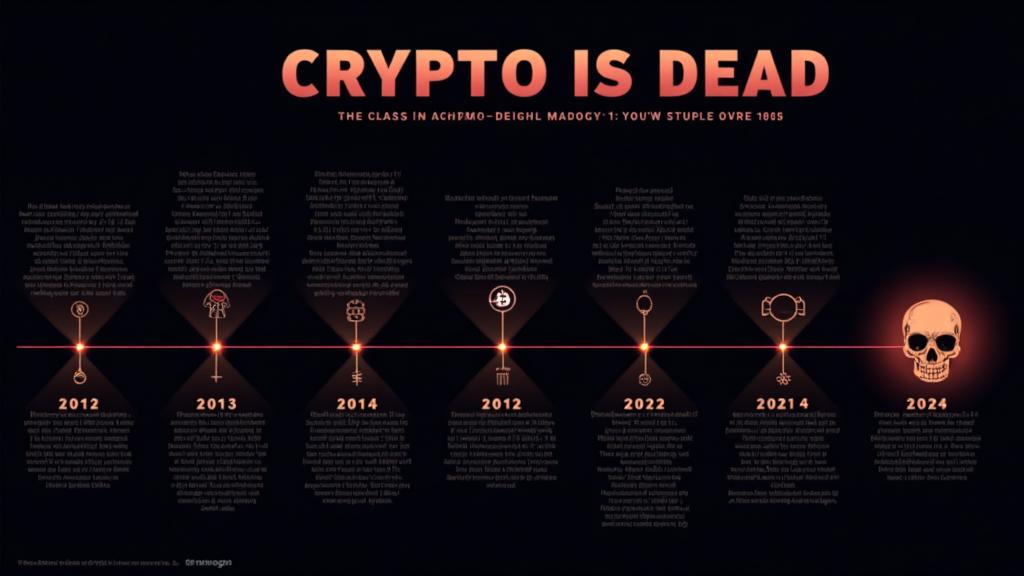
Bitcoin has been declared dead over 470 times. Every single obituary has been wrong so far. That does not guarantee future performance, but it does reveal a pattern worth understanding.
For a deeper analysis of Bitcoin specifically, read Is Bitcoin Dead? Why "Crypto Is Dead" Searches Are Surging Again.
Crypto Narratives Drive Every Cycle
One of the most important things to understand about crypto is that narratives drive capital flows. Each cycle is powered by a different set of stories.
In 2017, the narrative was ICOs and the promise of decentralized fundraising.
In 2020 and 2021, the narratives were DeFi, yield farming, and NFTs.
In 2024 and 2025, the narratives shifted to AI crypto, perpetual DEX protocols, and real world asset tokenization.
Each narrative attracts new capital, new builders, and new speculation. When the narrative fades, prices crash. When a new narrative emerges, capital rotates and the cycle begins again.
Understanding narrative rotation is one of the most valuable skills an investor can develop. If you want a detailed breakdown of the latest narratives shaping the market, read X402, Perpetual DEX, and AI Crypto Narratives.
Privacy technologies, new payment infrastructure, decentralized social media, and AI integrated protocols are all examples of narratives that are building momentum right now. Whether they become the dominant story of the next cycle remains to be seen. But the innovation pipeline is not slowing down, which directly contradicts the "crypto is dead" thesis.
Watch: Altcoin Narratives That Could Shape the Next Cycle
Prefer watching on YouTube? Watch here.
Why Investors Need Better Tools
Surviving crypto cycles requires more than conviction. It requires better analysis.
Most investors rely on social media for their information. That is a structural disadvantage. Social media is optimized for engagement, not accuracy. The loudest voices are rarely the most informed.
That is why it pays to use a small set of reliable tools for security, charting, and portfolio tracking instead of relying on social feeds. You can find a curated selection on the Crypto Resources page.
Good tools do not predict the future. They help you analyse narratives and market structure more effectively, which is exactly what you need during periods when everyone else is panicking about crypto being dead.
Crypto Is Not Dead. Investors Just Need to Be More Vigilant
Here is the part most people do not want to hear.
Crypto is not dead. But that does not mean everything in crypto is worth buying.
The industry has a serious problem with scams, weak projects, and hype cycles that extract money from retail investors. Every bull market produces thousands of tokens that have no real utility, no real team, and no real future.
When those projects collapse, people blame "crypto" instead of blaming the specific project they chose without doing research.
The responsibility falls on investors to develop better due diligence habits.
What does that look like in practice?
- Verify the team behind any project before investing.
- Check tokenomics for red flags like insider heavy allocations.
- Look at actual usage metrics, not just marketing claims.
- Be skeptical of any project that promises guaranteed returns.
- Understand the difference between a protocol and a token. A useful protocol can have a worthless token if the economics are poorly designed.
The long term winners in crypto are almost always built during quieter periods. When the hype dies down, the real builders keep working. When the next cycle arrives, those projects are positioned to capture the most value.
Crypto Infrastructure Keeps Growing
If crypto were truly dying, you would expect to see declining infrastructure. The opposite is happening.
Perpetual DEX trading continues to grow in volume and sophistication. Platforms offering decentralized derivatives trading are handling billions in daily volume without centralized intermediaries. This is real, measurable activity that did not exist just a few years ago.
Decentralized infrastructure projects are expanding. Protocols focused on decentralized compute, storage, and networking are attracting serious development talent and venture capital.
AI agents integrated with blockchain technology represent one of the most active areas of development in 2026. From automated trading systems to AI powered research assistants, the intersection of AI and crypto is producing real tools, not just hype.
Privacy focused technologies are seeing renewed interest as regulatory pressure increases globally. Projects building privacy preserving payment systems and communication tools are addressing a genuine market need.
New payment rails built on blockchain technology are processing real transactions in real time. From stablecoin payments to cross border remittances, the payment use case for crypto is stronger than ever.
None of this is theoretical. These are active, growing sectors with measurable traction. The idea that crypto is dead simply does not align with what is actually being built.
Market Cycles Are the Real Story
The most important concept for any crypto investor to understand is the market cycle.
Bull markets are defined by rising prices, increasing speculation, and narrative driven hype. Everyone feels like a genius. Risk feels low. New participants flood in at the worst possible time.
Bear markets are defined by declining prices, fear, and capitulation. People sell at a loss, declare the market dead, and leave. The loudest voices are the ones predicting further collapse.
Accumulation phases happen after bear markets and before bull markets. Prices move sideways. Volume is low. Interest is minimal. This is when experienced investors position themselves for the next cycle.
The transition from accumulation to bull market is rarely obvious in real time. It usually becomes clear only in hindsight. That is why so many people miss the best entry points.
Understanding where you are in the cycle changes everything about how you should be thinking and acting. If you are in an accumulation phase, panic selling is the worst possible decision. If you are in a euphoria phase, taking profits is the smartest move most people never make.
For a detailed breakdown of what happens during quiet, sideways markets and why they are so dangerous, read why sideways markets are the silent portfolio killer.
Watch Next
If you want a brutally honest perspective on what most investors get wrong, watch this:
Watch Next: 10 Brutal Truths I Wish I Knew Before Investing in Crypto
I regularly write about crypto market structure, narratives, and investment psychology. You can explore more of my analysis in the Crypto Market Analysis & Education section.
If you want to understand the bigger picture behind why fiat systems are weakening and what it means for Bitcoin, read The Hidden War for the Future of Money.
Frequently Asked Questions
Is crypto actually dying?
No. Crypto is not dying. The broader ecosystem continues to grow in developer activity, institutional adoption, infrastructure development, and real world usage. Individual projects do fail, but the industry as a whole is expanding.
Why do people say crypto is dead?
People say crypto is dead during bear markets when prices crash and fear spreads. Media outlets amplify the narrative because negative headlines generate more engagement. It is a recurring pattern that has appeared in every cycle since Bitcoin was created.
Can crypto recover after a crash?
Yes. Bitcoin has recovered from crashes of over 80 percent multiple times. The recovery timeline varies, but historically every major crash has been followed by a period of accumulation and eventually new all time highs. This does not guarantee future results, but the pattern is well established.
What are crypto narratives?
Crypto narratives are the dominant themes and stories that drive investor interest and capital flows during each market cycle. Examples include DeFi, NFTs, AI crypto, perpetual DEXs, and privacy protocols. Understanding narrative rotation helps investors anticipate where capital may flow next.
How should investors approach bear markets?
Bear markets are best approached with patience, discipline, and a focus on fundamentals. Reduce exposure to high risk positions, accumulate quality assets at lower prices, improve your research process, and avoid making emotional decisions based on fear.