I thought Cartoon Money was another memecoin. Then I opened the game, discovered a market of cartoon versions of major crypto assets, and realised there was a lot more happening under the hood.
Cartoon Money combines a real Solana token called CBUCKS with a virtual, cartoon-themed crypto marketplace. Inside its Coinmoonkitcap game, people can trade cartoon coins, buy the right to operate individual coin markets, launch those markets and, if eligible, use a launch-order tool called ToonBot. The cartoon coins are not actual Bitcoin, Ethereum or the projects they parody.
In this guide, I'll show you the basics, explain how ownership works, share the hidden features I found and cover the risks that are easy to overlook. I also recorded a full video walkthrough if you'd rather watch me go through it on-screen.
Disclosure: I have held CBUCKS and an in-game coin ownership. After I began covering Cartoon Money independently, the team gave me approximately $1,000 worth of CBUCKS through a creator promotion. My full disclosure and risk discussion appear below.
Quick answer: Cartoon Money isn't merely a CBUCKS price chart. Its game has approximately 500 cartoon markets. You can trade some virtual coins through the app, purchase ownership rights to particular markets, and potentially collect owner fees when users trade them. But it is speculative. The virtual coins are not normal transferable versions of the assets they imitate; some gameplay uses real USDC; and neither earnings nor profit are guaranteed. Read the current rules on the official Cartoon Money website before committing funds.
What is Cartoon Money, and what is CBUCKS?
Think of Cartoon Money as a crypto market turned into a cartoon game. It has a music-playing phone interface, characters and locations to discover, and a parody market tracker called Coinmoonkitcap. You can switch between phone and desktop-style views and explore markets by category or status.
There are two completely different things you must not mix up:
- CBUCKS is the real-world Solana crypto token associated with Cartoon Money. Like any speculative token, its market price can rise or fall sharply.
- cBitcoin, cEthereum, cZcash and the other “c” coins are virtual markets inside the game. They are not holdings of BTC, ETH or ZEC, nor are they endorsed by those projects. The game says these in-game coins have no independent value outside its platform.
That distinction is important because an in-game cBTC price chart is not the Bitcoin chart, and buying the virtual coin is not buying Bitcoin. It is also important because the game uses real USDC for some activities, so “virtual” does not mean “no financial risk”. Always verify exactly what balance you are spending, what you receive and how exits or refunds work.
The project describes itself as being built and controlled by agentic AI. That's an intriguing part of its branding, but it is not proof that the technology is autonomous, that funds are safe or that no person can control the system. Those are separate questions.
Why I paid attention, even after dismissing it
I first heard about Cartoon Money from fellow creator Crypto Gains in October 2026. At the time I'd been disappointed by some memecoin trades and wasn't especially keen to jump into another one. I initially put in a few hundred dollars, cut the exposure back to roughly $130–$150 and nearly dismissed the whole thing.
Then the position moved sharply. I took profits, looked more closely at the website, and discovered the ownership and trading mechanics. What caught my attention wasn't just a rising token; it was how the product packaged a launchpad, market activity, character customisation, scarcity and discovery into one experience.
I have worked in marketing, sales and consumer psychology for more than 25 years. From that angle, I can understand why the game is sticky: it invites you to explore, collect, watch new launches and come back. That's clever product design. It is not an investment guarantee. In fact, the more engaging a speculative product feels, the more important it is to control how much you spend.
How to start playing Cartoon Money safely
1. Open the official website
Go directly to cartoon-money.com, check the domain carefully and select Play. Avoid lookalike links sent by strangers. You can look around at public markets before connecting a wallet.
2. Explore Coinmoonkitcap
You'll see cartoon assets with a “c” prefix, for example cBitcoin or cSolana. The menus include areas such as Top Coins, Buy Ownership, Live Coins, New Coins and Categories. You can also find your profile and portfolio, with separate trading and ownership views when connected.
Pay attention to the status of each market. Live means users can trade it. At launch means the relevant market is not yet open for normal trading. Owned means someone has acquired the associated ownership right; it does not automatically mean the coin has launched.
3. Connect a wallet only when you need to act
My demonstrations use a Phantom wallet. For an unfamiliar game or dApp, I recommend using a separate low-balance wallet account, not the wallet holding your main crypto investments. Confirm the site URL and review every wallet signature and transaction. Never type a recovery phrase or private key into a website. Solana network fees may require SOL, and particular game actions can require USDC or CBUCKS.
4. Start by learning the screen, not by making a large trade
Before you spend anything, inspect the markets, the difference between trading and ownership, the displayed fees, and the game's official How to Play information. The buttons are simple; the economics need more attention.
How to buy and sell cartoon coins
This is the first of the game's main activities: trading a live virtual market.
- Open Live Coins or select a market marked Live.
- Choose the cartoon coin, for example cBitcoin, which is not real Bitcoin.
- Select Trade and inspect the buy/sell interface.
- Enter an amount and carefully review the displayed USDC cost, fees, price impact and any slippage setting.
- If you're comfortable with the terms, approve the operation in your connected wallet.
- Check the trading portfolio to see the position. If and when a sell option is available, review its current quote and fees before selling.
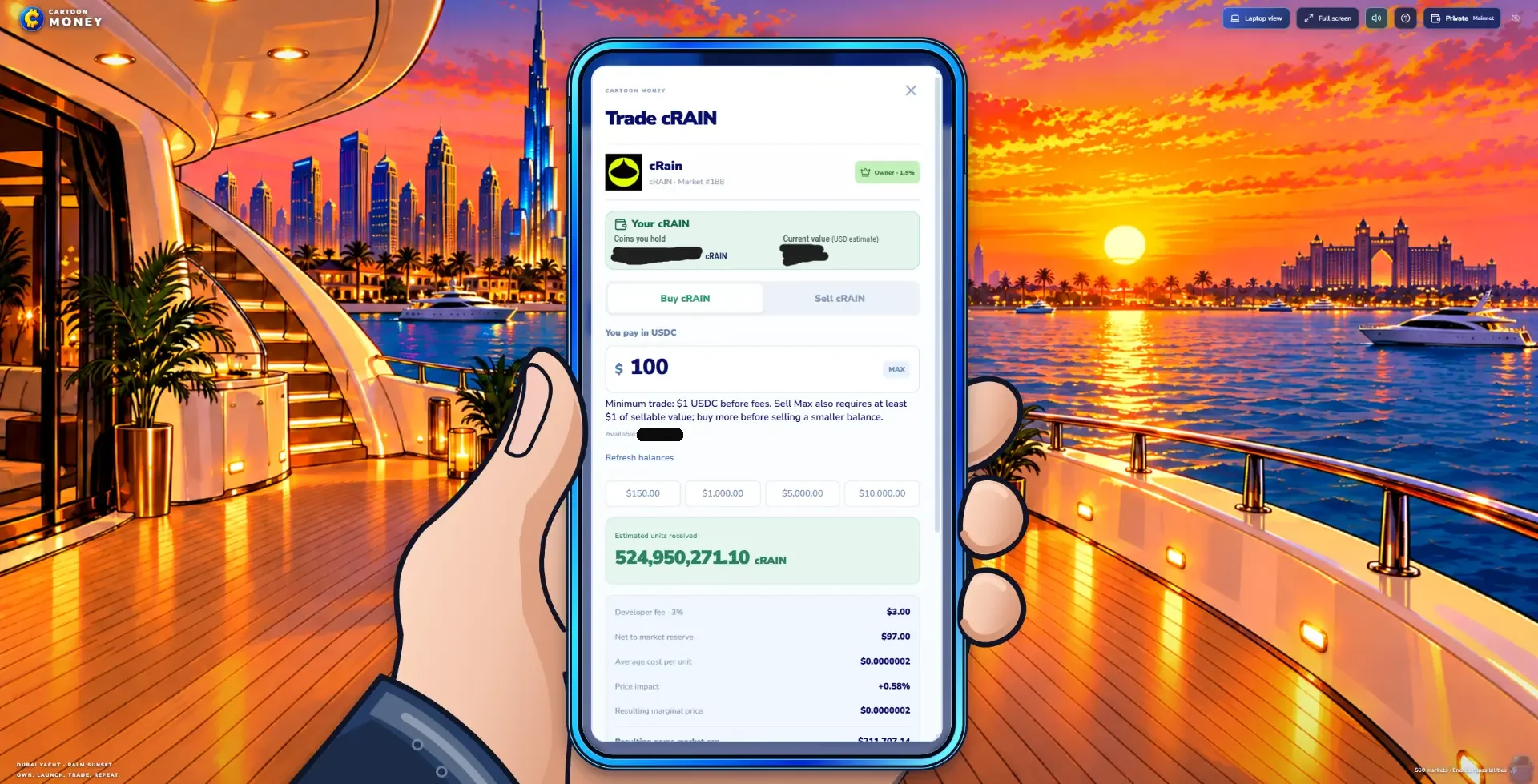
Do not assume a quoted gain is a realised profit. What matters is what you can actually receive after fees, execution and any game-specific rules. Low activity or a wide spread can make an exit more difficult than an attractive-looking chart suggests.
In my video I experiment with very low slippage, but 0% isn't a universal recommendation. An overly tight setting can also prevent a trade from executing. Decide based on the current quote and understand what you are signing.
What does it mean to “own” a Cartoon Money coin?
Here's the part I initially found most interesting: buying a virtual coin for trading is different from buying the ownership of its market.
Buying cBitcoin through Trade gives you exposure to that particular in-game market. Buying cBitcoin ownership, if available, means purchasing the game's ownership right associated with that market. The owner may be able to launch the market, potentially earn an owner fee when others buy and sell, and offer the ownership for resale.
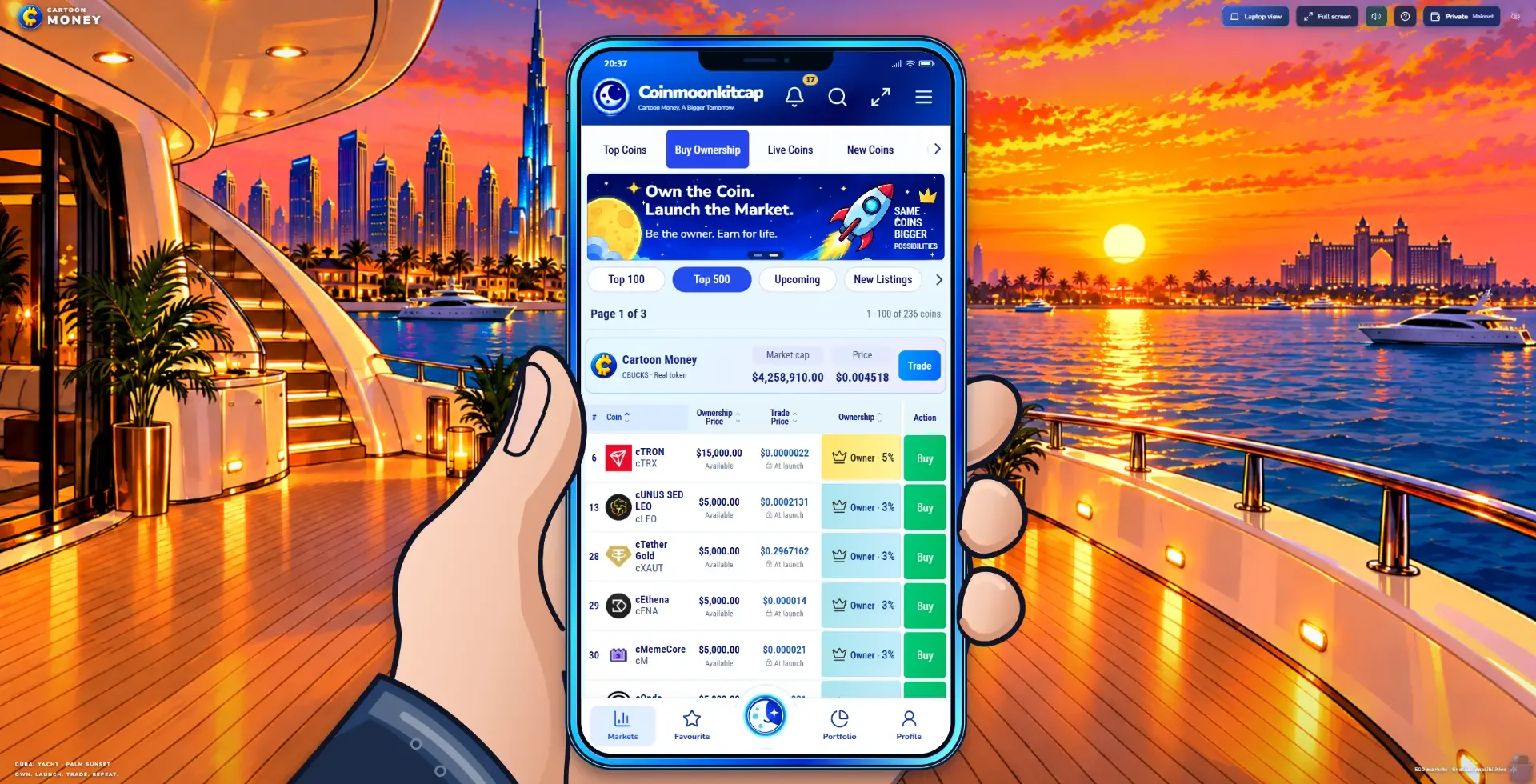
The platform presents ownerships in different tiers, with different upfront prices and fee percentages. As examples visible on the official site when this guide was researched, cBitcoin displayed a 7% owner-fee tier, cTRON displayed 5%, and several mid-ranked markets displayed 3%. Other tiers exist, and prices and availability can change. These figures refer to the platform's displayed owner-fee tiers, not a guaranteed investment return, yield or share of all platform revenue. Read the current game terms for how fees are calculated and settled.
Why would anyone buy ownership?
Imagine owning the virtual market for a cartoon coin that becomes popular. If players actively trade that market, the ownership may generate fee income under the game's rules. You may also be able to sell the ownership to another player through the marketplace.
But there are two catches. No trading activity means little or no fee activity, and an ownership listed at a higher price does not mean a buyer will appear. In the video I show lower-cost tiers becoming scarce and second-hand listings with asking prices above their original purchase prices. Those are asking prices, not automatically completed sales or proof of future value.
How to inspect or buy ownership
Open Buy Ownership, choose a market and check whether it is Available, already Owned, or Not listed for resale. Review the purchase price, owner-fee tier, market status and applicable terms. If the item is already owned, you may need to find a listing or submit an offer rather than buy directly from the game.
Keep a clear separation between your trading portfolio (virtual coin positions) and ownership portfolio (markets you own). They are not the same asset or the same type of risk.
How launches work, and why timing matters
Some cartoon markets are owned but not yet live. As I demonstrate in the walkthrough, an owner can control the timing of a market's launch, subject to the platform's rules. Until a coin launches, normal trading may not be available.
This creates the game's collector-and-launch dynamic: some people buy ownership hoping to attract traders to their market; others watch upcoming launches to participate as traders. Don't assume every market will launch promptly or attract useful trading volume.
Hidden trick #1: Find ToonDEX with 21 taps
One of the more entertaining details is the game's hidden navigation. In my video, I found a character in the profile area who offers a tip. That tip points to a moon button.
In the version I demonstrated, tapping the moon button 21 times reveals ToonDEX. Yes, 21: the same number that immediately makes Bitcoin people think of its 21-million-coin supply.
It's a fun Easter egg, but remember that hidden menus and interfaces can change. If the steps no longer work, check the in-game instructions rather than clicking random third-party links claiming to unlock something.
Hidden trick #2: Find ToonBot through Dubai Beach
ToonBot is more than a hidden screen. It is the game's launch-order feature, and the official website currently advertises it as live.
The discovery path shown in my walkthrough: open your profile, select the private jet environment, lower the cartoon phone and knock on the jet door 21 times. The character can offer to take you to Dubai Beach. At the beach, explore the yacht and talk to the character there to discover ToonBot. You may need to connect your wallet and meet the eligibility requirements to use it.
The official site independently hints at exploring Dubai to find ToonBot, but treat the precise number of taps and character locations as a snapshot of the game I demonstrated, not an immutable rule.
What are the ToonBot requirements?
According to Cartoon Money's official website, you must meet and maintain both of these requirements:
- Hold at least $2,000 worth of CBUCKS.
- Own at least two coin ownerships, of any tier.
That's $2,000 worth of CBUCKS, not $2,000 in USDC, and the conditions can become unmet if the market value of your CBUCKS falls or you sell an ownership. These requirements may change, so check the website at the time you act.
What does ToonBot actually do?
ToonBot lets an eligible user select a planned coin launch and reserve a chosen USDC budget in advance. When the coin owner launches that market, ToonBot attempts eligible orders in queue order before ordinary trading opens. Normal trading begins once the queue finishes or its priority window ends.
Crucially, early access does not guarantee execution or profits. The official site says orders depend on the chosen limits and successful on-chain execution, and that unspent budgets can be refunded. Understand the full order rules and refund process before using it. This is an execution tool, not a profit bot.
Is CBUCKS worth buying just to use the game?
Not necessarily. You can explore the platform before deciding whether you need to hold CBUCKS at all. The real token may have a role in eligibility and ecosystem activity, but that does not establish a fair price or a dependable source of future demand.
I have been enthusiastic about the concept on YouTube, and I can see how it could grow if the team continues developing the product and people keep coming back. I can also see the risks: speculative token pricing, thin liquidity, in-game economic rules, dependency on the platform, anonymous or hard-to-verify control, and the possibility that momentum fades.
Don't confuse “great idea” with “great investment at any price.” I don't. If you're going to speculate, know in advance how much you can afford to lose and how you'll take profits rather than letting excitement write your trading plan.
The security checks I would make
- Verify the official website and Solana CBUCKS contract address from the project's official channels. The address published on its official X launch post is
DtcicPCKTKeAh7TDEzTym3hXeoHAoMiBdYJhMYxZpump. - Use a separate, low-balance wallet for interacting with the game and inspect wallet approvals.
- Read the current How to Play, owner-fee and transaction terms; do not rely only on someone else's YouTube tutorial.
- Distinguish real CBUCKS or USDC movements from virtual in-game coin balances.
- Ask how profits, ownership proceeds and refunds are actually settled before risking meaningful amounts.
- Remember that an “AI-built” label is not an audit, guarantee or substitute for knowing who can change a platform.
If the mechanics seem confusing, start with the walkthrough and use the official website to check what has changed since it was recorded.
Don't let the game decide your risk
The biggest losses in crypto often come from psychology, not charts. Get my free weekly Crypto Factor email and the 21 Crypto Rules guide.
My verdict: clever game, real risk
Cartoon Money surprised me. As a product and marketing concept, it does something that most memecoins don't: it gives people a world to explore and multiple reasons to return. Market ownership and ToonBot add depth beyond watching a token chart.
But there is no obligation for the market to reward the idea. Nor does a virtual marketplace remove real financial risks when CBUCKS and USDC are involved. Treat it as a speculative experiment, don't put your main wallet at risk, and do not confuse a fee percentage with guaranteed income.
If you want to see exactly where I click, watch Cartoon Money Explained: How to Play + Hidden Tricks. For the earlier story and my initial market thesis, see I Thought Cartoon Money Was a Joke. I also discussed the project in my Crypto Markets & Cartoon Money livestream.
And if you'd like one useful crypto email a week (less noise, more investor psychology and practical lessons), join my free Crypto Factor newsletter. You'll also get my 21 Crypto Rules guide while it's the current signup bonus.
Frequently Asked Questions About Cartoon Money
Is Cartoon Money a real cryptocurrency?
CBUCKS is a real token on Solana. The many cartoon coins inside Coinmoonkitcap are virtual in-game markets and are not actual BTC, ETH or other underlying assets. Some platform activities use real USDC, so understand the transaction before paying.
How do I play Cartoon Money?
Visit the official cartoon-money.com website, select Play and explore Coinmoonkitcap. You can review live cartoon markets, inspect ownership offerings and customise a profile. Trading and ownership-related actions may require a connected wallet and funds.
Do I need CBUCKS to trade cartoon coins?
CBUCKS is the project's real token and is required for some features, most notably ToonBot eligibility. The trading walkthrough demonstrates USDC-based purchases of virtual cartoon coins. Check the current in-game requirements before transacting; don't assume all features require the same balance.
Is cBitcoin the same as Bitcoin?
No. cBitcoin is a cartoon-themed, virtual in-game market. It is not BTC, does not give you real Bitcoin ownership and is not affiliated with Bitcoin's underlying network.
How do Cartoon Money coin ownerships make money?
The platform advertises different owner-fee percentages associated with other users' trading in a particular virtual market. Actual receipts depend on activity, fee calculations and the game's current terms. Owning a market does not guarantee earnings or a profitable resale.
What are the requirements for ToonBot?
The official site currently requires at least $2,000 worth of CBUCKS plus two coin ownerships of any tier, with both requirements maintained. ToonBot separately uses a reserved USDC budget for planned launch orders.
Does ToonBot guarantee I get into a coin before others?
No. Orders are queued and subject to limits and successful execution. Normal trading opens after the queue or priority window, and early access does not guarantee a fill or profit.
How do I find ToonDEX and ToonBot?
In my video, 21 presses of the moon button revealed ToonDEX. ToonBot was found by knocking 21 times on the private-jet door, travelling to Dubai Beach and exploring the yacht. These are game-version-specific Easter eggs, so verify the current interface.
Is Cartoon Money safe?
There are material risks associated with CBUCKS price volatility, wallet connections, use of real funds, ownership liquidity, execution and the platform's operation. Its claim to be AI-built is not a substitute for an independent security assessment. Use a separate wallet and never commit funds you cannot afford to lose.
Sources, videos and disclosure
Official project: Cartoon Money · Official Cartoon Money X profile
Token context: CBUCKS on Pump
Watch: Beginner walkthrough · My earlier assessment · Livestream discussion
Related Crypto Factor reading: Crypto Candlestick Patterns · Find the Right Crypto Wallet · Crypto Education
Disclosure: I hold or have held a personal position in CBUCKS and have bought in-game coin ownership. I began covering Cartoon Money independently. As disclosed in my latest video, the team later sent me approximately $1,000 worth of CBUCKS through a creator promotion after I reached out to ask whether they supported creators. I was not required to make these videos as part of that arrangement. That gift is material and may create a conflict of interest. This article reflects my own experience and analysis, not a guarantee of safety or returns. Educational content only; not financial advice.