Summary
If you are trading crypto and still not using AI properly, you are leaving an edge on the table.
That does not mean AI should trade for you. It does not mean you should throw away technical analysis, follow lazy prompts, or ask a chatbot to spit out buy and sell signals. That is not smart trading. That is outsourced thinking.
The real value of AI in crypto trading is much simpler and much more powerful. AI helps you save time, reduce bias, filter weak setups, challenge your assumptions, and focus on trades that actually fit your style.
That is the point of this article.
In this guide, I will show you how I think about AI in crypto trading, what most traders get wrong, what AI should actually be doing for you, and a few practical tools that can help you make better decisions without turning you into a lazy trader.
Quick Answer
The best way to use AI for crypto trading is not to let it trade for you, but to use it for faster analysis, better filtering, and clearer decision making. AI works best when it helps you reduce bias, validate setups, check risk, and save time while you still control the final trading decision.
---
In this guide:
Table of Contents
- Why Most Crypto Traders Use AI Wrong
- What AI Should Actually Help You Do
- What AI Should Not Do for You
- Why AI Matters More in Crypto Than in Most Markets
- 3 Practical Ways I Use AI in Crypto Trading
- 7 Practical Ways to Use AI in Crypto Trading
- Why AI Still Needs a Trading Framework
- Where the Factor Line Fits In
- Final Thoughts
- FAQ
---
Watch the Full Video Breakdown
How to Use AI for Crypto Trading Without Becoming a Lazy Trader
---
Why Most Crypto Traders Use AI Wrong
Most traders hear the term AI and immediately go in one of two bad directions.
The first group thinks AI is magic. They want instant entries, instant exits, and instant profit. They want a robot to tell them exactly what to buy, when to buy it, when to sell it, and how rich they are going to get. These are usually the same people who want shortcuts everywhere else too.
The second group dismisses AI completely. They think it is hype, fake guru nonsense, lazy prompting, and recycled content. They assume it has no place in serious trading because they associate it with low-quality signal sellers and social media noise.
Both groups miss the point.
AI is not useful because it replaces thinking. It is useful because it improves the quality of your thinking when used correctly.
That is especially important in crypto because crypto traders are constantly dealing with noise. They are hit with narratives, influencers, headlines, moon targets, fear, greed, and a ridiculous amount of low-quality market commentary. If you do not have a filter, you are going to get pulled in every direction.
AI can become part of that filter.
The problem is that many traders use AI the same way they use social media. They use it to confirm what they already want to believe. If they are bullish, they ask bullish questions. If they are bearish, they ask bearish questions. If they want a coin to go up, they frame every prompt around why it should go up.
That is not analysis. That is just faster self-deception.
Serious traders use AI differently. They use it to challenge assumptions, review structure, analyze context, and reduce wasted time. They are not asking AI to become their brain. They are asking it to become a support tool inside a process.
That is a massive difference.
---
What AI Should Actually Help You Do
AI is most useful when it helps you do the work that takes time, creates friction, or increases bias.
For example, a trader may have five or ten charts on the radar but only one or two that actually fit the way they trade. AI can help narrow that list by highlighting structure, trend context, support and resistance, and what still needs confirmation.
For the chart-reading framework behind that process, read my guide to crypto candlestick patterns, including context, volume, confirmation and invalidation.
It can also help with the tedious research that most traders either avoid or do poorly.
That includes things like:
- checking whether a coin has weak momentum relative to Bitcoin
- identifying whether a project looks suspicious on-chain
- testing whether a market thesis actually matches price behavior
- spotting whether a trader is forcing a narrative onto a chart
- helping you organize your own process more clearly
This is where AI becomes valuable.
It helps you save mental energy for the parts that matter most.
Good trading is not just about entries and exits. It is about managing attention. If you spend too much time reading noise, chasing headlines, double-checking random projects, or manually reviewing weak setups, your performance suffers even before you place a trade.
AI helps clean that up.
Done right, AI can help you:
- reduce confirmation bias
- reduce emotional decision making
- save hours of repetitive research
- compare setups more efficiently
- catch red flags faster
- create a more consistent trading workflow
This is also why AI fits crypto so well.
Crypto has more noise, more scam risk, more narrative distortion, and more emotional volatility than most other markets. Any tool that helps reduce those problems already has value.
---
What AI Should Not Do for You
This part matters because traders often go wrong here.
AI should not become an excuse to stop thinking.
It should not replace:
- your risk management
- your trading framework
- your understanding of structure
- your patience
- your judgment
If you are asking AI to take trades for you with no framework, you are not using AI well. You are just outsourcing responsibility.
The same goes for lazy prompts.
A lot of traders open a generic chatbot and type things like:
- Is Bitcoin bullish?
- What coin will pump next?
- Give me a trade setup.
- Tell me if I should buy this now.
Then they get generic garbage back and decide AI is useless.
That is not an AI problem. That is a user problem.
Weak prompts produce weak output. Vague questions produce vague answers. Biased questions produce biased reinforcement.
AI also should not become a substitute for technical analysis. Technical analysis still matters because structure still matters. Price still matters. Context still matters. Market behavior still matters. If you want to strengthen that foundation, this guide to candlestick patterns is a useful starting point.
AI is most useful when it works with your process, not instead of it.
That is the key distinction.
Use AI to sharpen your process, not to avoid building one.
---
Why AI Matters More in Crypto Than in Most Markets
Crypto moves fast. Narratives change quickly. Scams show up constantly. New coins appear overnight. People get pulled into hype loops with almost no verification. On top of that, traders are forced to deal with emotional extremes more often than in most traditional markets.
That makes AI more useful here than many people realize.
In crypto, traders often lose not because they cannot read a chart, but because they get distracted, overloaded, or manipulated.
A headline makes them bullish when the chart says caution.
An influencer posts a chart with ten random lines on it and suddenly everyone thinks that chart is genius.
A narrative starts trending on X and traders convince themselves that price has to follow.
This is where AI can help pull you back toward reality.
It can help you ask:
- Does the chart actually support this idea?
- What is price doing right now, not what do I hope it will do?
- Is this coin really worth my attention?
- Is this just another weak narrative with no structure behind it?
- Am I about to trade emotion instead of evidence?
That is valuable.
Crypto also rewards speed, but not reckless speed. The right kind of speed comes from better filtering. If AI helps you eliminate weak ideas faster, you have more time and attention for the setups that actually matter.
That alone can improve performance.
---
3 Practical Ways I Use AI in Crypto Trading
I do not use AI as a magic signal box. I use it as an edge enhancer.
Here are three practical ways I think traders should use AI in crypto.
1. Use AI to review chart structure faster
The first use case is chart review.
Sometimes you want a quick second layer of analysis on what price is doing. Not because you cannot think for yourself, but because you want clarity. You want to know whether the chart is trending, consolidating, rejecting resistance, or still missing confirmation.
That is useful when:
- you are scanning multiple charts
- you want to challenge your own analysis
- you want to fact check another trader's chart
- you want to reduce blind spots
This is one reason I like the idea behind the article on AI crypto trading tools for beginners. That piece explains how beginners can use AI tools to reduce noise, improve filtering, and build a more practical workflow before they start overcomplicating everything.
For more advanced traders, the same principle still applies. Speed matters, but clarity matters more.
2. Use AI to filter coin quality and risk
The second use case is project filtering.
Crypto traders waste a huge amount of time on coins that should never have been on their radar to begin with. Some are weak. Some are low-conviction. Some are scams. Some are obvious opportunity-cost traps.
AI can help you identify:
- suspicious project characteristics
- possible honeypot risk
- poor relative strength
- weak trend behavior
- low capital efficiency
That does not mean AI becomes your final judge. It means AI helps you avoid wasting time on garbage.
This is huge because avoiding bad trades is just as important as finding good ones.
3. Use AI to challenge your own psychology
The third use case is the one most traders ignore.
AI can help expose your own emotional mistakes.
That includes:
- confirmation bias
- revenge trading
- overtrading
- narrative addiction
- obsession with price targets
- influencer-led decision making
For example, if you are bullish because of a headline, AI can help you compare that headline against what price is actually doing. If you are fixated on a target, AI can help highlight what the chart still needs to confirm before that target even becomes realistic.
This is where AI becomes more than a tool. It becomes a mirror.
And a lot of traders need that.
---
7 Practical Ways to Use AI in Crypto Trading
You do not need fifty tools. A free tier of a mainstream AI assistant such as ChatGPT, Claude, or Gemini covers most of these uses. What matters is having a clear reason for each one. For a broader overview of free options, see free AI and crypto tools for investors.
1. Summarizing Information
Paste long threads, reports, or project announcements and ask for the key points. This saves time and helps you separate substance from noise.
2. Research
Use AI to explain unfamiliar concepts, tokenomics, or how a protocol works. It speeds up learning, but treat it as a starting point, not a final source.
3. Comparing Projects
Ask AI to compare two projects on use case, competition, token supply, and risks. This forces you to look beyond price and narrative.
4. Idea Generation
AI can suggest questions you have not asked yet: what could invalidate this trade, which sectors are related, what the bear case looks like.
5. Journaling
Describe each trade, your reasoning, and the outcome, then ask AI to spot patterns in your mistakes. Over time this exposes habits like overtrading or chasing headlines.
6. Risk-Checking
Before entering a trade, upload a chart screenshot and ask what still needs confirmation, where the setup fails, and whether your position size makes sense. It is a structured second look, not an instruction to obey.
7. Scenario Analysis
Ask AI to map out bullish, bearish, and sideways scenarios and what each would require. This prepares you to react with a plan instead of emotion.
AI should support your decisions, not replace them. It can be confidently wrong, so always verify prices, contract addresses, and facts against primary sources, and never let it override your risk management rules. For charting, wallets, and other resources, see the Crypto Resources page.
---
---
Why AI Still Needs a Trading Framework
Here is where a lot of people stop too early.
Even if you use the best AI tools available, you still need a framework.
Why?
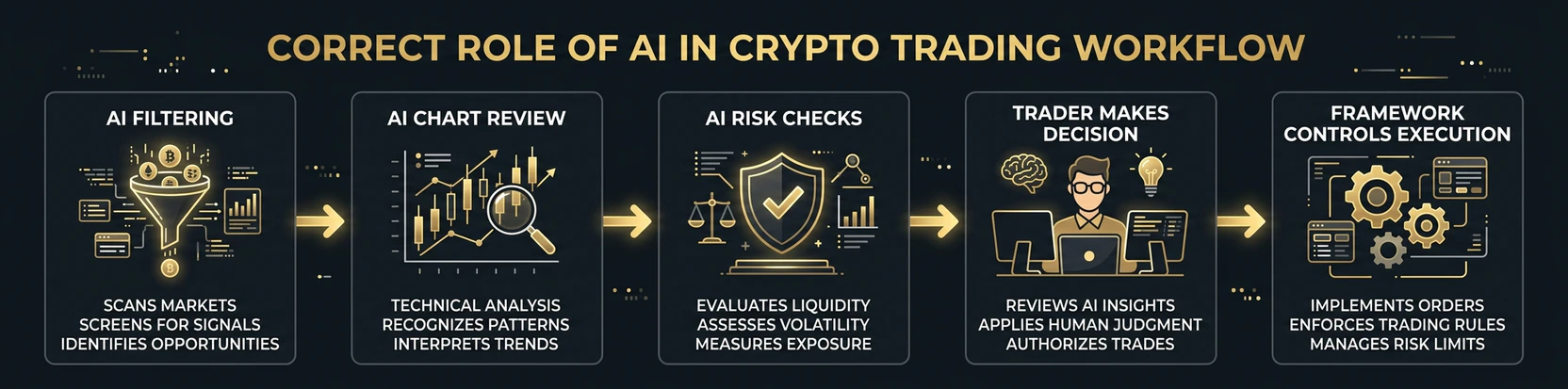
Because AI can help with filtering, context, and analysis, but at some point you still need a process for:
- entering a trade
- sizing a trade
- managing risk
- taking profit
- deciding when to stay out
Without that framework, AI just makes you faster at bouncing between ideas.
That is not an edge.
Real edge comes from combining:
- better information
- better filtering
- better structure
- better execution
Most losing traders do not actually need more opinions. They need fewer opinions and a more reliable process.
That is why AI alone is not enough.
It can help you think more clearly, but it cannot replace the need for a repeatable approach.
If you want more context around that idea, my article on AI crypto trading tools for beginners explains how AI improves decision making when it is used as part of a simple workflow instead of as a shortcut.
That article is a good companion piece to this one because it focuses more on beginner application, while this piece is about using AI correctly as a trader.
---
Where the Factor Line Fits In
At some point, traders need more than filtering. They need structure they can trust.
For me, that is where the Factor Line fits.
The Factor Line is the indicator and framework I built specifically for crypto. It is designed to simplify trend-following, swing trading, and higher-timeframe decision making without turning the process into a mess of random indicators.
That matters because many traders do the opposite. They pile on complexity, confuse themselves, and mistake busyness for skill.
A better approach is to use AI for:
- faster filtering
- chart review
- bias reduction
- coin quality checks
Then use a structured framework for:
- deciding when a setup is valid
- confirming trend behavior
- managing entries and exits
- staying consistent
That is the role of the system.
If you want to understand that part better, explore my flagship crypto trading course. It explains the role of the Factor Line in a more direct way and helps connect the dots between analysis and execution.
That is also where this article differs from generic AI hype.
I am not telling you to let AI replace your process.
I am telling you to use AI to improve the quality of your process.
That is a much more serious way to trade.
---
Final Thoughts
If you are trading crypto and still not using AI properly, you are leaving time, clarity, and edge on the table.
Not because AI is magic.
Because AI helps you filter better, think more clearly, and waste less energy on the wrong things.
That is what serious traders should care about.
The market is already hard enough. You do not need to make it harder by relying on pride, instinct, random influencers, or generic headlines. You do not need to use AI like a toy either.
Use it to challenge your thinking.
Use it to verify what matters.
Use it to save time where time should be saved.
Use it to reduce bias where bias usually wins.
Then build your actual trading decisions on a framework you understand.
That is the real point.
If you treat AI as a shortcut, it will probably make you worse.
If you treat AI as a tool inside a structured process, it can absolutely make you better.
For more analysis, trading breakdowns, and AI crypto content, subscribe to The Crypto Factor on YouTube.
---
FAQ
What is the best way to use AI for crypto trading?
The best way to use AI for crypto trading is for analysis, filtering, and validation, not blind signal-following. AI is most useful when it helps you review chart structure, check coin quality, compare opportunity cost, and reduce emotional bias before you make the final decision.
Can AI replace technical analysis in crypto trading?
No, AI should not replace technical analysis. It should support it. Technical analysis helps traders understand structure, trend, and market behavior, while AI helps speed up analysis, reduce noise, and challenge weak assumptions.
Do serious crypto traders actually use AI?
Yes, serious traders can use AI as a support tool, especially for filtering information, checking project risk, reviewing charts, and improving process. The key difference is that serious traders use AI to sharpen judgment, not to avoid building judgment in the first place.
Are AI crypto tools better than trading signals?
In most cases, yes, because good AI tools help you think more clearly instead of telling you what to do blindly. Signals encourage dependency. Useful AI tools improve research, structure, and context, which helps traders become more independent over time.
Is AI useful for beginner crypto traders?
Yes, AI can be especially useful for beginners because it helps simplify analysis and reduces the chance of getting pulled around by hype and bad information. The important thing is to use AI as a learning and filtering tool, not as a replacement for patience, discipline, and risk management.
---
About the Author
Paul Democritou is a crypto educator, keynote speaker, and Web3 marketing strategist. He is the creator of The Crypto Factor, a platform that covers crypto investing, macro analysis, and the future of money. Follow his work on YouTube and X.